
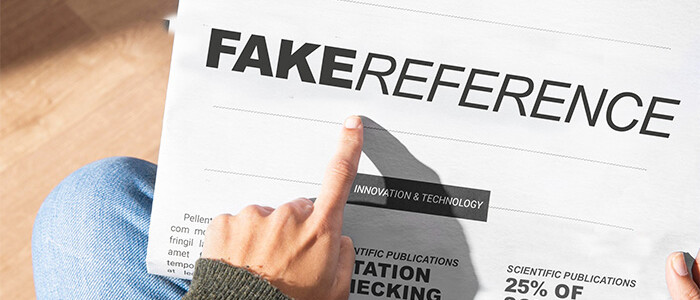
Citation fraud detection is essential for maintaining research integrity. Citation fraud does not always involve obvious manipulation. It can take the form of a genuine reference used out of context. It may also involve a completely fabricated source. For editorial boards, knowing how to detect citation fraud before publication has therefore become an essential skill.
The four main types of citation fraud
There are several forms of citation fraud. Moreover, each requires a specific detection method. Understanding these practices helps editorial teams identify suspicious references before accepting a manuscript.
1. Fabricated citations
The reference simply does not exist. For example, it may point to a fictitious article or attribute research to an author who never published it. This is why systematically checking DOIs can often help identify this type of fraud quickly.
Editorial teams can use tools such as Crossref to check whether an article exists and whether its bibliographic details match the cited reference.
2. Misrepresented citations
The cited source does exist. However, it does not support the author’s claim. In some cases, it may even contradict it. As a result, this type of fraud remains particularly difficult to detect using automated tools.
3. Citations to retracted publications
In this case, the author cites an article that the journal has retracted after publication. However, the author may simply be unaware of the retraction. Therefore, this situation calls for systematic checks using specialized databases such as Retraction Watch.
4. Citation Cartels
A group of authors or journals cite each other disproportionately. The aim is to artificially boost certain metrics, particularly journal impact factors. Consequently, analyzing cross-citation patterns can help identify these practices.
Warning signs for effective citation fraud detection
Even before checking individual references, certain warning signs should raise concerns. For example, a bibliography containing an unusually high number of references on a very narrow topic may appear suspicious. Similarly, an unusually high rate of self-citation should prompt further investigation.
Furthermore, some DOIs lead to articles that differ from those listed in the bibliography. These inconsistencies are also important warning signs. Therefore, editorial teams should investigate such anomalies before accepting a manuscript.
Although these signals do not always indicate deliberate fraud, they can help journals identify references that require closer examination.
Why manual citation verification is not enough
A research paper’s bibliography often contains anywhere from 30 to more than 100 references. However, checking every source takes considerable time, especially for volunteer peer reviewers. Moreover, this task comes in addition to the scientific evaluation of the manuscript.
As a result, editorial boards often struggle to verify every reference systematically. Consequently, some irregularities may go unnoticed before publication.
This is why a structured citation screening process can help editorial teams reduce the risk of publishing manuscripts with inaccurate or misleading references.
Automated detection before Peer Review
The good news is that automated tools can detect most of these warning signs. They can verify whether a reference exists, identify retracted publications, and detect unusually high levels of cross-citation between authors or journals. All these checks can take place before a human reviewer becomes involved.
Of course, this does not replace the editorial board’s scientific judgment. However, it turns a time-consuming manual process into a systematic screening step that can be applied to 100% of submissions.
Ultimately, this is what separates journals that detect citation fraud before publication from those that discover it afterward, as discussed in our article on paper mills.
By combining automated reference checks with expert editorial review, journals can strengthen research integrity and identify potential citation manipulation before an article reaches publication.
–
LibScience develops an automated bibliographic reference verification solution for scientific journals and publishers, including the detection of retracted articles, automatic DOI enrichment and contextual citation relevance checking. Discover LibScience